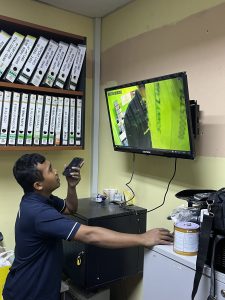
How AI CCTV Improves Factory Security and Productivity
Factories today run on tight margins, complex supply chains, and round-the-clock operations. A single security breach, equipment failure, or safety incident can halt production for hours and cost far more than the price of prevention. This is why more manufacturing and industrial facilities are moving away from traditional CCTV toward AI-powered surveillance systems that do far more than simply record footage.
AI CCTV doesn't just watch — it thinks. It can detect unusual behaviour, flag safety violations, count production line stoppages, and alert security teams in real time, all while reducing the manual workload of monitoring dozens of camera feeds. For factory operators, this translates directly into fewer losses, safer workplaces, and measurably better productivity.
Why Traditional CCTV Falls Short in Industrial Environments
Conventional CCTV systems are reactive by design. Footage is typically reviewed only after an incident has already occurred — a theft, an accident, or unauthorised access. In a factory environment with dozens of entry points, loading bays, and production zones, relying on human operators to watch every screen simultaneously is simply not realistic.
This gap creates blind spots that can lead to:
- Delayed response to safety incidents on the production floor
- Unnoticed unauthorised access to restricted or hazardous zones
- Inventory shrinkage that goes undetected for weeks or months
- Inefficient use of security staff who are stretched across too many tasks
How AI CCTV Changes the Equation
Real-Time Threat and Anomaly Detection
AI-powered cameras use computer vision and machine learning to analyse footage as it happens, not after the fact. The system can distinguish between a person walking a normal route and someone loitering near a restricted area, or detect when a forklift enters a pedestrian zone. Alerts are pushed instantly to security personnel, allowing them to respond within seconds rather than discovering the issue during a routine review days later.
Production Line and Workflow Monitoring
Beyond security, AI video analytics can track operational metrics such as line stoppages, bottlenecks, or unusual idle time at specific stations. Management gains visibility into where inefficiencies occur without needing separate monitoring hardware, effectively turning the security investment into an operational intelligence tool as well.
Automated PPE and Safety Compliance Checks
Many industrial accidents stem from missed safety protocol — a worker without a helmet, gloves, or safety vest in a hazardous zone. AI CCTV can be trained to recognise personal protective equipment compliance and flag violations automatically, supporting occupational safety programmes without requiring constant human supervision.
Smarter Access Control Integration
When paired with an access control system, AI cameras can cross-verify that the person entering a restricted zone matches an authorised badge or credential, adding a second layer of verification that dramatically reduces the risk of tailgating or credential misuse.
Key Benefits for Factory Operators
| Area | Traditional CCTV | AI-Powered CCTV |
|---|---|---|
| Incident Detection | After the fact, via manual review | Real-time automated alerts |
| Staffing Requirement | Constant manual monitoring | Reduced, exception-based monitoring |
| Safety Compliance | Manual spot checks | Automated PPE and zone detection |
| Operational Insight | Limited to security use | Extends to productivity analytics |
Choosing the Right AI CCTV Setup for Your Factory
Not every facility needs the same configuration. A food processing plant with hygiene zones has different requirements than a heavy machinery warehouse. Key considerations include camera placement for full coverage of entry points and production zones, network bandwidth to support continuous AI video processing, and integration with existing security infrastructure such as access control and alarm systems.
Facilities exploring a broader upgrade often start with a comprehensive factory security solution that combines AI CCTV, access control, and network design into a single, coordinated system rather than isolated components that don't communicate with each other.
A well-integrated AI CCTV system doesn't just reduce risk — it becomes part of the operational backbone of a modern factory, feeding data that supports both security and business decisions.
Implementation Best Practices
Start with a Site Assessment
Before installing any hardware, a proper site survey identifies blind spots, high-risk zones, and network readiness. This prevents costly rework later.
Prioritise Network Reliability
AI video analytics depend on stable bandwidth. A poorly designed networking system can cause dropped frames or delayed alerts, undermining the very real-time benefits AI CCTV is meant to deliver.
Plan for Scalability
Factories expand and reconfigure production lines often. Choosing a system architecture that allows additional cameras and analytics modules to be added without a full redesign saves significant cost down the line.
Conclusion
AI CCTV has moved well beyond simple recording. For factories, it represents a shift from reactive security to proactive risk management — catching safety violations before they become accidents, flagging unauthorised access before it becomes theft, and surfacing operational bottlenecks before they affect output. As industrial facilities face growing pressure to do more with fewer resources, AI-powered surveillance is fast becoming a baseline requirement rather than a luxury upgrade.
Frequently Asked Questions
What makes AI CCTV different from standard CCTV?
AI CCTV uses computer vision and machine learning to analyse footage in real time, detecting specific behaviours, objects, or anomalies automatically, rather than simply recording video for later manual review.
Can AI CCTV integrate with our existing factory systems?
In most cases, yes. AI CCTV can be integrated with access control systems, alarm systems, and networking infrastructure, although the level of integration depends on the age and compatibility of existing equipment.
Does AI CCTV require a lot of bandwidth?
AI video analytics are more bandwidth-intensive than basic recording, which is why a properly designed network is essential for smooth, real-time performance across multiple camera feeds.
Is AI CCTV suitable for small and medium-sized factories?
Yes. Systems can be scaled to match facility size and budget, starting with critical zones such as entry points and expanding coverage over time.
How does AI CCTV help with productivity, not just security?
Beyond detecting security threats, AI analytics can track line stoppages, idle time, and workflow bottlenecks, giving management operational data that supports process improvements.
Related Solutions:
Need help designing an AI-powered surveillance or integrated security solution for your business? Contact Zashtech for a free consultation.